SparkLab

SparkLab is a research group whose founding team comes from Tsinghua University and the University of Hong Kong, united by a shared commitment to advancing trustworthy physical intelligence. Guided by a research-driven vision, we pursue foundational work across algorithms, evaluation, hardware, and data, building a full-stack research team where ideas are not only conceived, but rigorously tested, embodied in real systems, and made reliable in the physical world.

If you are interested in research collaboration or have any questions, please contact us at sparklab@xsparkai.com.We also have several open research positions. See our Career Opportunities page for details.

Our Embodied AI Model is On The Way.

Coming Soon

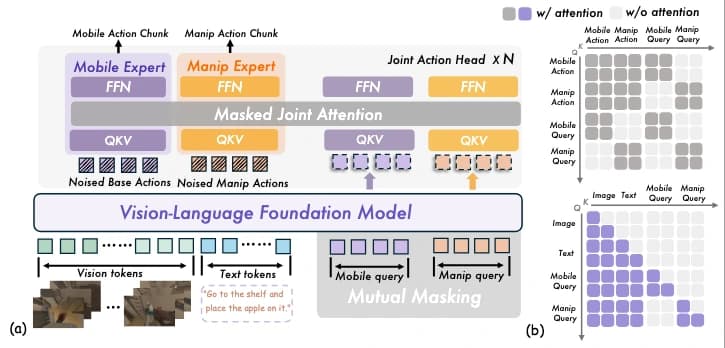
MoPA: Coordinated Mobile Manipulation via Subsystem-Specific Perception Alignment

MoPA is a robotic mobile manipulation framework that extracts distinct perceptual features for base motion and arm control while coordinating both during action generation. It improves performance on complex tasks such as object sorting and cross-table transfer, achieving state-of-the-art performance across all three task suites of the ManiSkill-HAB benchmark. Across four real-world tasks, MoPA achieves an average full-task success rate of 76.3%, outperforming the strongest baseline by 12.5 percentage points.

MoPA coordinated mobile manipulation framework overview

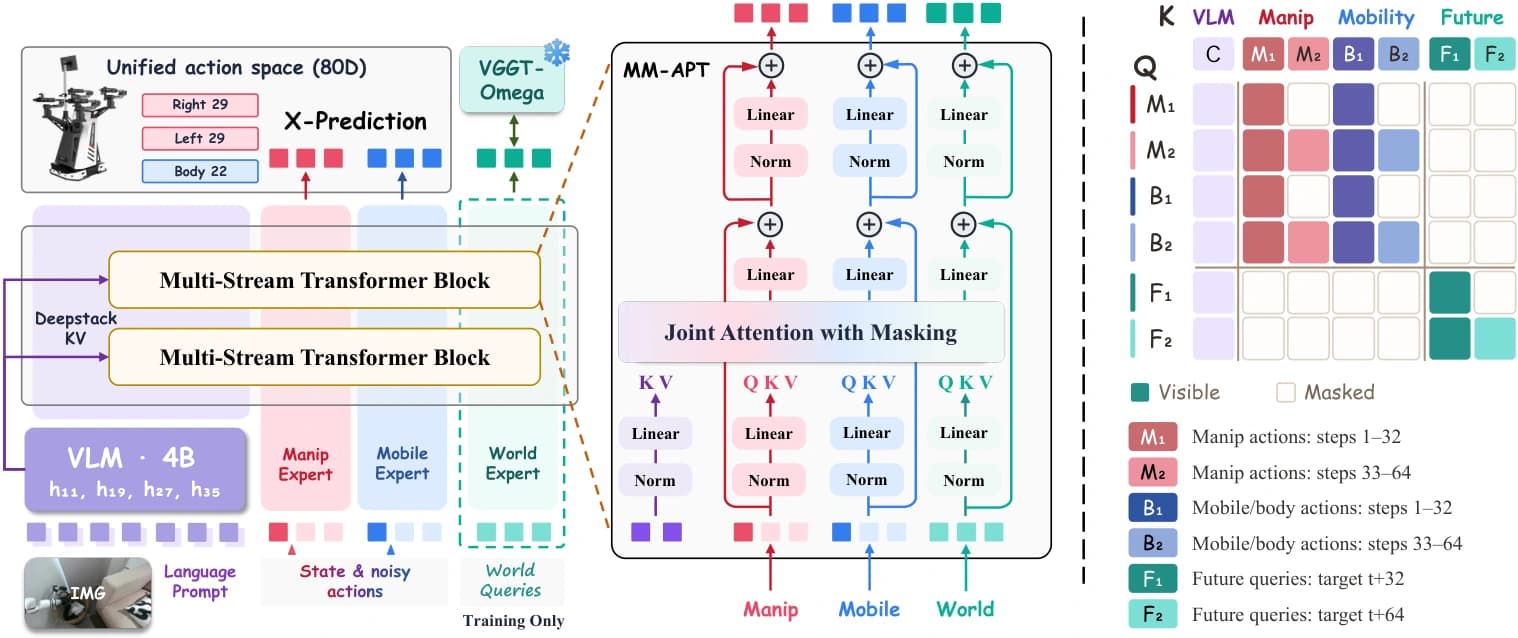
MM-ABC: Towards Generalist Mobile Manipulation via Seeing, Coordinating and Imagining

MM-ABC is a foundation model for generalist mobile manipulation that combines multi-level vision-language features for spatial perception, dual-stream action modeling for arm–base coordination, and future geometric feature prediction as auxiliary supervision during training. Pretrained on over 5,000 hours of robot data spanning 17 embodiments, it demonstrates strong performance across multiple simulation benchmarks and achieves an average success rate of 83% across five real-world tasks.

MM-ABC generalist mobile manipulation foundation model overview

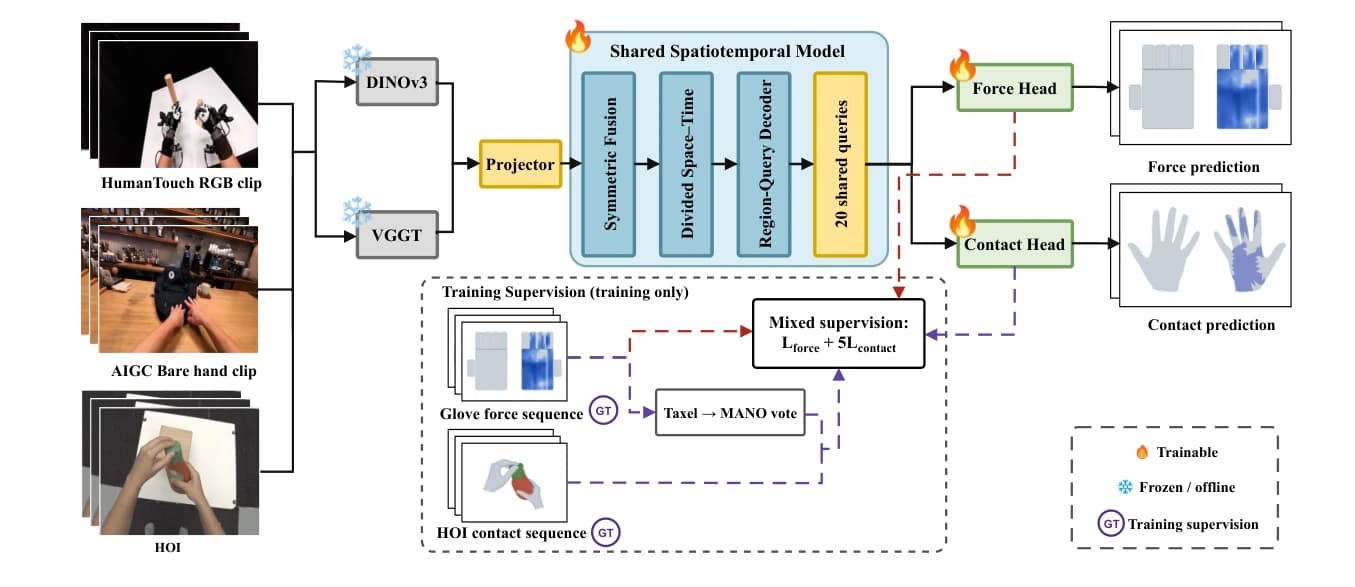
TouchSight: Bare-Handed Tactile Prediction from Egocentric Video via Generative Visual Augmentation

TouchSight predicts dense full-hand contact forces from monocular egocentric video without tactile sensors at inference. The framework learns from 500 hours of pressure-glove recordings and additional hand–object interaction data, using generative video augmentation to convert selected gloved clips into bare-hand footage while retaining measured tactile labels. This helps bridge the visual gap between instrumented training data and natural hand interactions. TouchSight outperforms prior contact prediction methods on OakInk2 and demonstrates qualitative generalization to unseen real-world bare-hand videos.

TouchSight predicting bare-hand contact from egocentric video

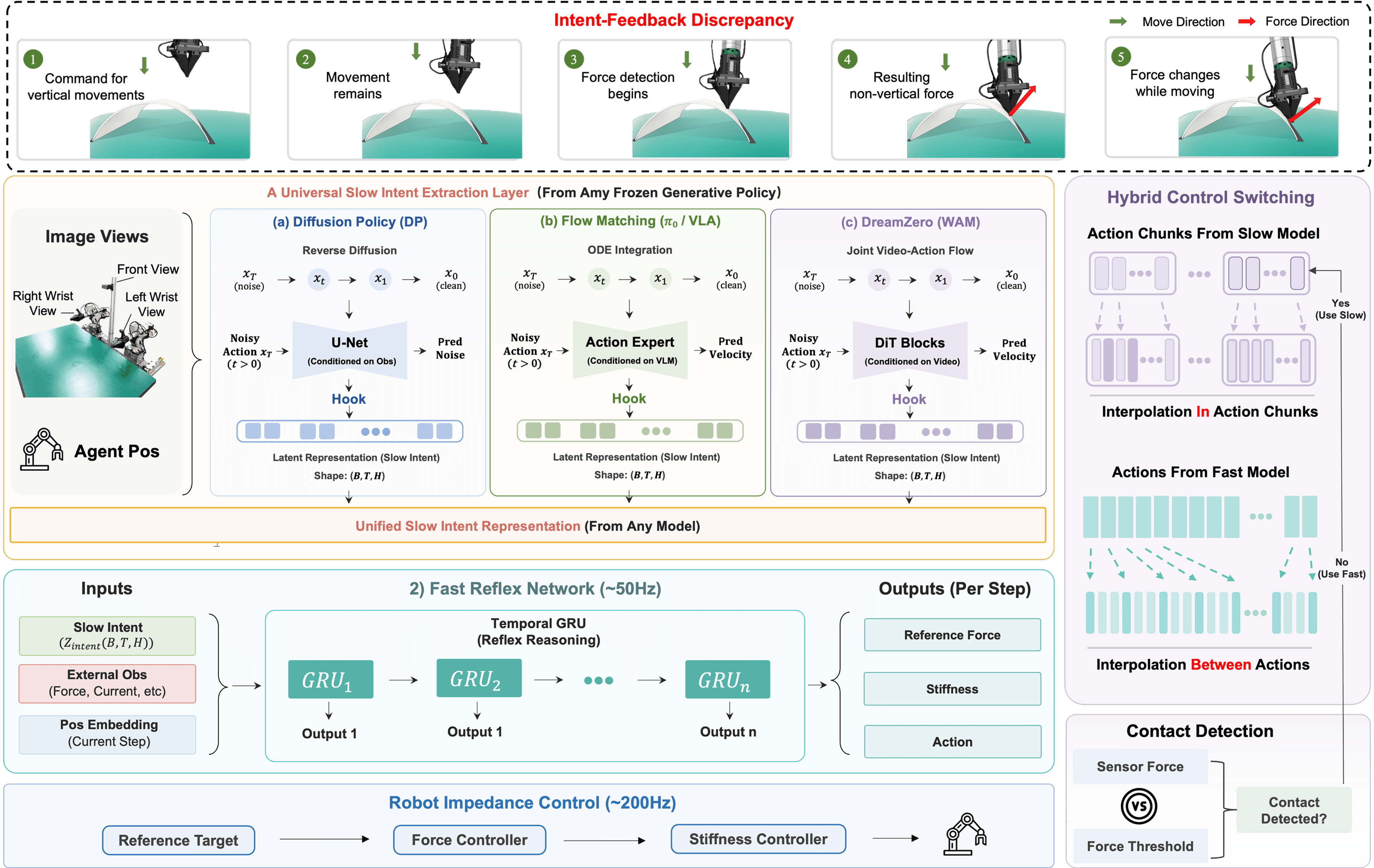
UniReflex: Plug-and-Play Force Control for Pretrained Generative Policies via Fast-Slow Reflex

UniReflex is a plug-and-play robot force-control framework. It requires no fine-tuning of existing robot policies and realizes variable impedance control via a lightweight network, enabling intelligent switching between position planning and force-control execution modes. The framework improves the stability and success rate of robotic contact-based operations while accelerating inference, making it suitable for various precision contact manipulation tasks.

UniReflex fast-slow reflex architecture for plug-and-play force control

HumanTouch: A Multimodal System for Scalable Human-Hand Tactile Acquisition

HumanTouch combines touch, hand motion, and vision within a calibrated and traceable acquisition system. It treats scalability not simply as recording more hours, but as collecting contact data that remains interpretable and trustworthy.

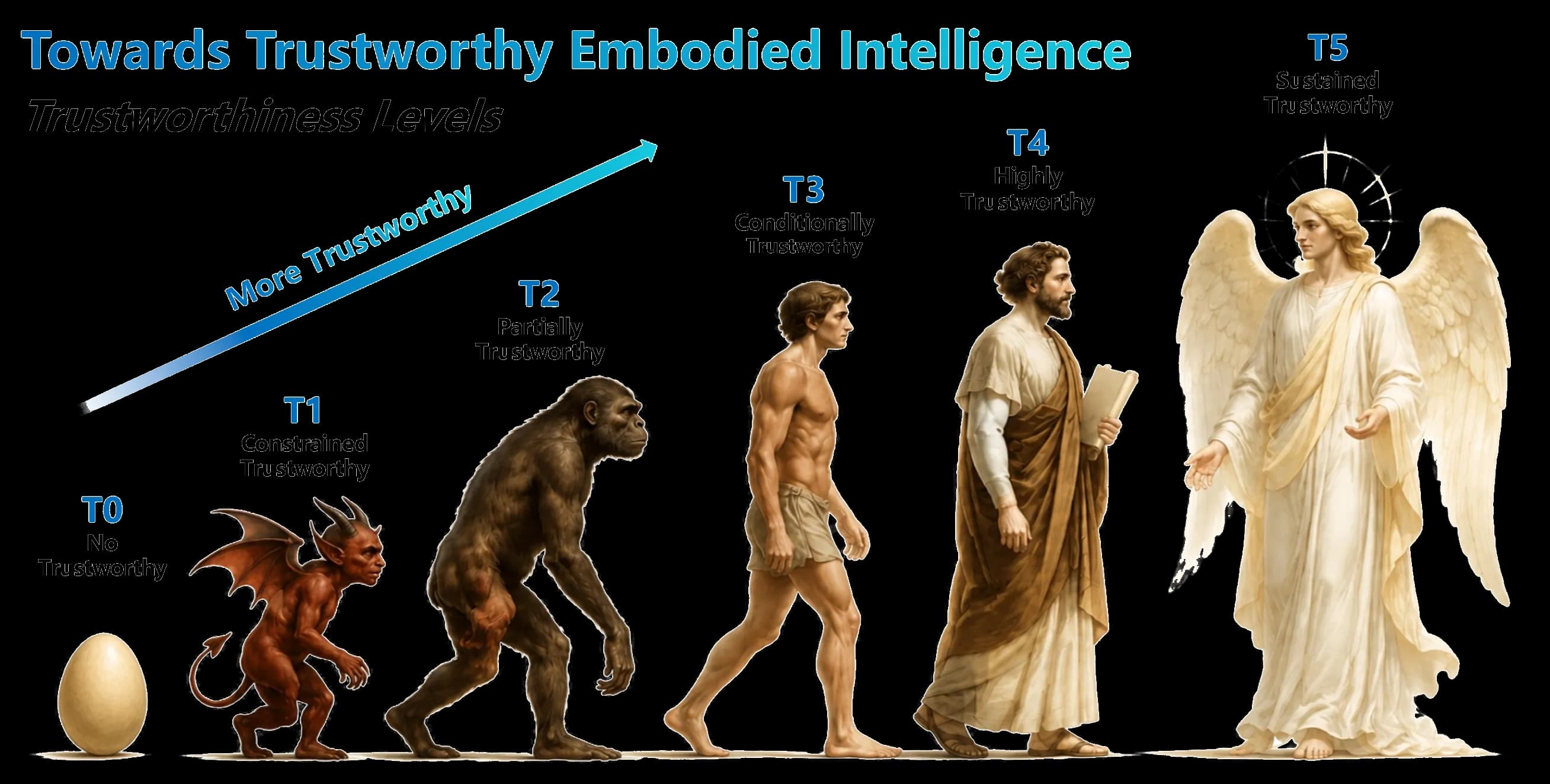
Trustworthy Embodied Systems: Framework and Levels

Toward trustworthy embodied intelligence: we systematically review prior work and propose a six-level framework (T0–T5) for grading trustworthiness.

Trustworthiness levels for embodied intelligence systems from T0 to T5

Previous Works

Nature Sensors
Published:2026/1/15

Biomimetic multimodal tactile sensing enables human-like robotic perception

SuperTac integrates pigeon-eye-inspired multispectral vision, triboelectric sensing, and inertial sensing into a flexible tactile skin just 1 mm thick. Paired with DOVE, an 8.5-billion-parameter tactile-language model, it transforms complex tactile signals into interpretable, actionable semantic information. Achieving over 94% accuracy across texture, material, slip, collision, and color recognition, SuperTac advances robotic touch from signal acquisition toward human-like perception and environmental understanding.

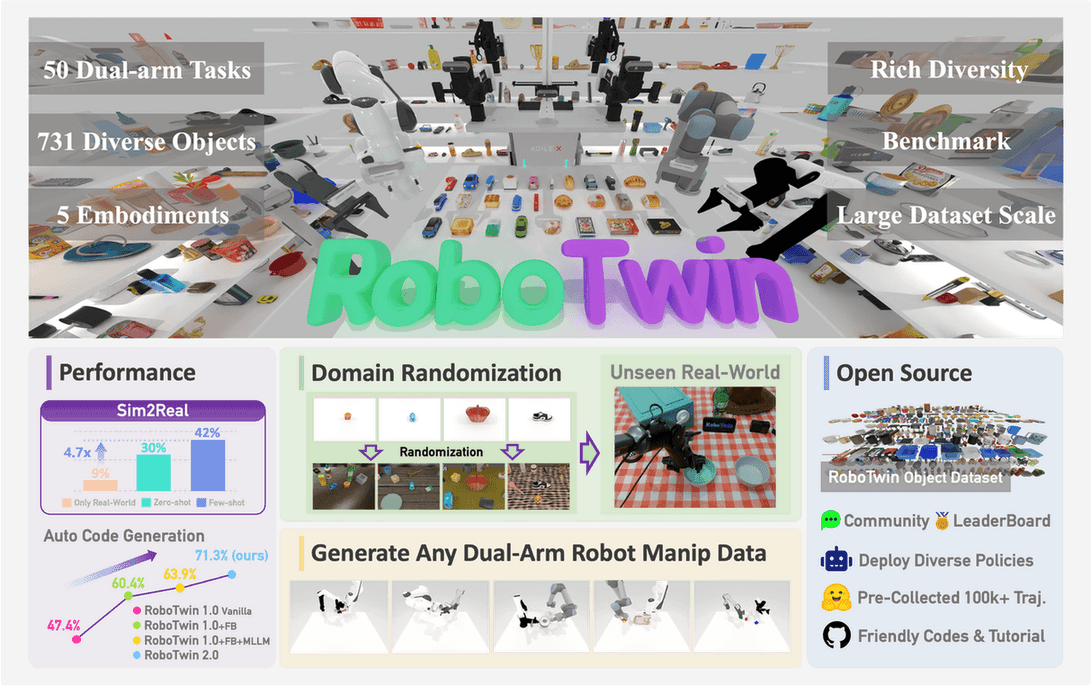
Overview of the RoboTwin 2.0 data generator and benchmark
ICML 2026
Published:2025/6/28

RoboTwin 2.0: A Scalable Data Generator and Benchmark with Strong Domain Randomization for Robust Bimanual Robotic Manipulation

We built a general-purpose bimanual manipulation data generator and benchmark, introducing strong domain randomization as an evaluation measure. RoboTwin is now among the most cited bimanual manipulation benchmarks in the community. As of July 30, 2026, the series has received more than 600 Google Scholar citations, 2,500 GitHub stars, and 600,000 Hugging Face downloads.

ICRA 2026 ViTac · Best Paper
Published:2026/8/10

UniVTAC: A Unified Simulation Platform for Visuo-Tactile Manipulation Data Generation, Learning, and Benchmarking

We present the field's first visuo-tactile simulation data synthesizer and evaluation suite, systematically study tactile data synthesis methods, and close the gap from simulation to real world deployment.

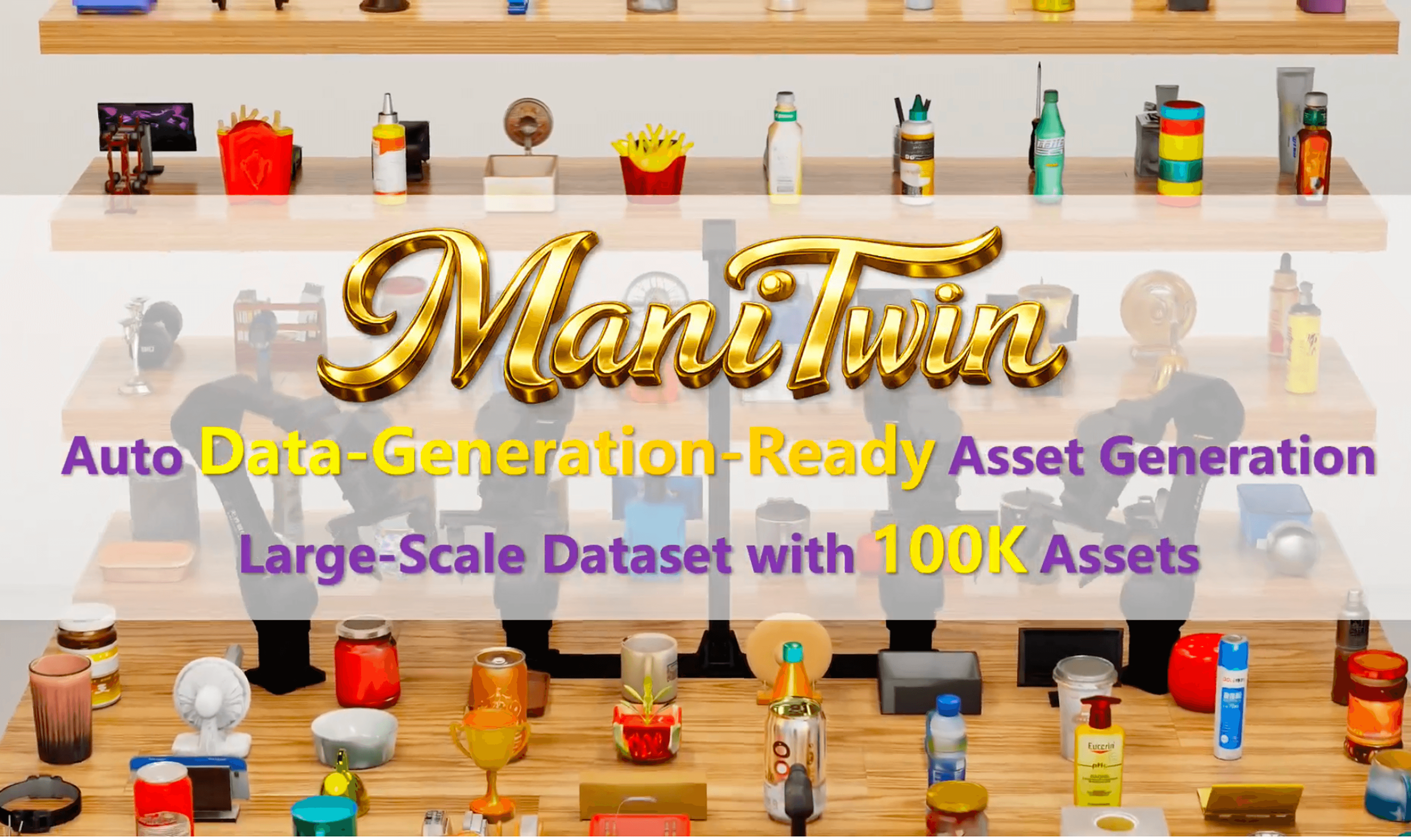
ManiTwin's 100,000-object manipulation-ready dataset
Under Review

ManiTwin: Scaling Data-Generation-Ready Digital Object Dataset to 100K

Together with Deemos Tech, we introduce the first large-scale rigid-object dataset with 100,000 manipulation-annotated assets, ready to plug directly into simulation-based data generation pipelines.